Available Across Victoria – Contact Us Now!

Available Across Victoria – Contact Us Now!
Every site has gaps.
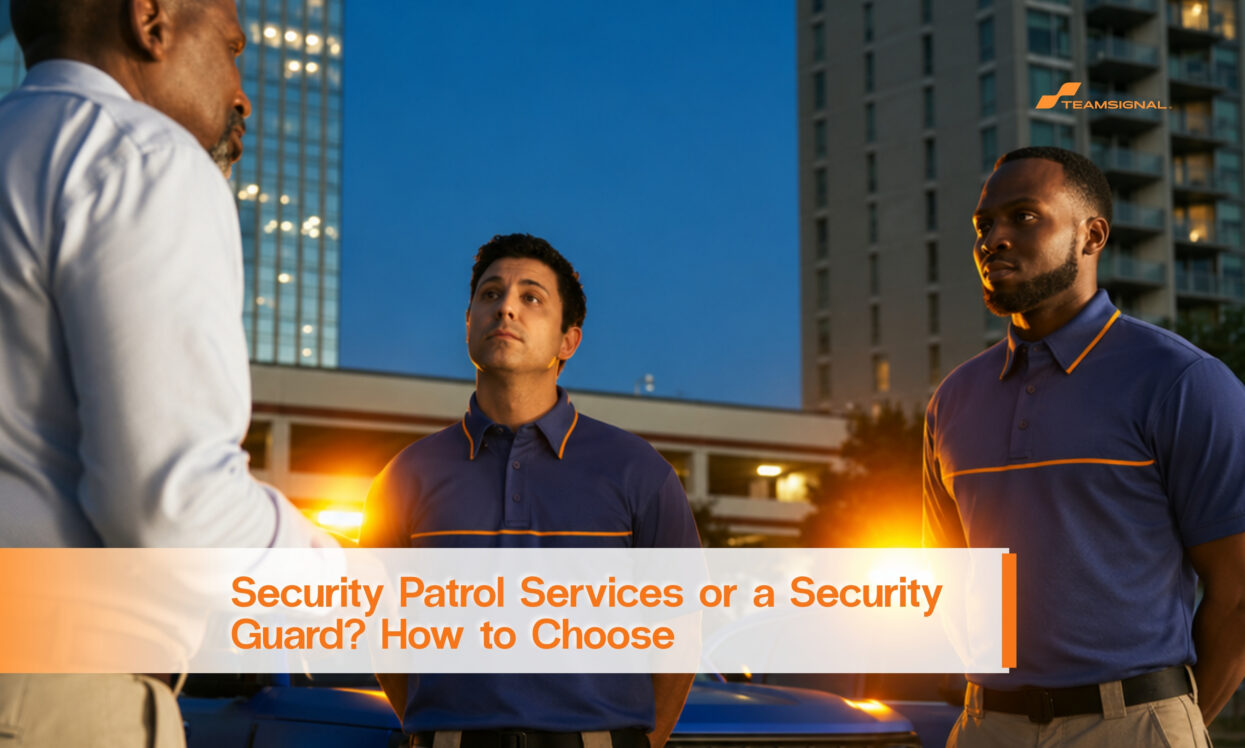
A security patrol visits your site at set or random times, then moves on. A security guard stays on site for a whole shift. A patrol suits a site that is empty at night and mainly needs checking. A guard suits a site where people come and go, or where access must be controlled all the time. Most sites need one, some need both, and a few need neither.
Team Signal Security is a full service security provider in Australia that runs both mobile patrols and dedicated security officers. We have no reason to push you toward one. This article shows how security patrol services work, what a guard does that a patrol cannot, and how to match the choice to your site.
A security patrol service sends a trained officer in a marked vehicle to your property. The officer checks the places that matter, such as gates, doors, car parks, loading areas and boundaries, then reports what they found. Our mobile patrol services can run on a fixed schedule or at random times, depending on the hours and risks of the property.
The key point is shared time. One patrol officer covers several properties in one shift. That is why a patrol gives you a visible security presence without paying for an officer to stand at one location all night. GPS-supported patrol records and electronic reports then show when the officer attended and what they checked.
A patrol visit can also include lighting checks, help with locking up and opening up, and attendance after an alarm activation. That last point matters. An alarm tells you something has happened. A patrol officer who can attend gives someone a reason to go and look, which is the step most alarm-only sites are missing.
If you want to see what one visit looks like from the inside, our guide to what happens on a mobile patrol visit walks through the checks and the report.
A guard is there the whole time. That changes what the officer can do. Our security personnel can manage access, check visitors, watch nominated areas, respond to incidents as they start and support your staff on site. None of that works from a vehicle that left twenty minutes ago.
A guard also changes how people behave. Staff, customers and visitors can see a person whose job is to notice problems. For a site with public access, that visible presence is often the main reason to pay for one.
Our guide on how security guards deter crime at commercial properties goes further into how deterrence works and what a guard can and cannot do.
The honest weakness of a patrol is time. Between visits, nobody from the patrol is on your site. Random timing makes the gaps harder for an offender to predict. It does not remove them.
Here is a simple illustration, not a client case. Say a warehouse is covered by four patrol visits across a twelve hour night. Spread evenly, the visits fall about three hours apart. An offender who needs ten minutes to take what they came for has a long window to work with. A guard on the same site would shrink that window to the time it takes to walk from one end of the property to the other.
This is why visit numbers matter as much as the decision between patrol and guard. We cover that in more detail in how many mobile patrol visits your site needs.
These are simple illustrations, not client cases. They show how the same questions give different answers.
Take a timber yard that closes at 5pm, has no one on site overnight and keeps its stock outside. The main risks are trespass, damage and theft of tools after dark. A patrol that checks the gate, the fence line and the shed at random times fits that risk well. Add a monitored alarm on the office and shed, and the yard has two layers for a fraction of the cost of a guard.
Now take a function centre that runs late events with alcohol and a public car park. People arrive and leave at all hours. Someone needs to watch the door, manage the car park and step in when a guest becomes a problem. A patrol that visits twice a night cannot do any of that. A guard on site can.
| Question | Security patrol service | Security guard on site |
| Where is the officer? | Visiting, then moving on to the next site | On your site for the whole shift |
| Who controls access? | Not usually. The patrol checks that doors and gates are secure | The guard can check people in and out |
| What happens at 2am if something starts? | The next visit, or an attendance after an alarm | The guard is already there |
| How is cost shaped? | By the number of visits, shared across clients | By the hours you roster, for one site |
| Best for | Empty sites, car parks, yards, closed offices | Busy sites, public access, high value stock |
| Proof of work | GPS records and electronic reports | Shift reports and incident logs |
Neither column is better. They answer different questions. The right one depends on what you are trying to stop and how much of it can happen between visits.
Work through these for your own site. Honest answers usually make the choice clear.
First, is anyone on site overnight? If staff or visitors are present, a guard is easier to justify. If the site is empty, a patrol often covers the real risk.
Second, how fast can something be taken? Fuel, copper and tools can go in minutes. A long gap between visits matters more for fast theft than for slow damage.
Third, does the site need access control? Checking who comes in is a guard task. A patrol can only confirm that locked doors are still locked.
Fourth, what do you already have? A monitored alarm or camera system fills part of the gap between visits. Our comparison of CCTV and mobile patrols explains how the two layers fit together, and it is worth reading before you buy either one.
Fifth, how much risk can you carry between visits? If one missed hour would hurt, add cover. If it would not, a lighter patrol schedule may do.
We will not quote prices in an article. They depend on the site, the hours and the award rates that apply to officers. What we can explain is how the cost is built.
A guard costs the rostered hours, so a long overnight shift is paid in full whether or not anything happens. A patrol is priced by visits, and the officer's time is shared across several clients. Our guide to how mobile patrol pricing works and our breakdown of what security guards cost in Melbourne set out the mechanics in detail.
Whichever you choose, the same licensing rules apply. Victoria Police regulates the private security industry through its Licensing and Regulation Division. Since 19 June 2025, all private security activities in Victoria are licensed activities, so patrol and guard work both sit inside the same system.
A public register of licence holders exists for businesses and individuals to confirm licences. Some older registrations stay valid during the transition, which is why the register, rather than a card alone, is the reference point.
A patrol is the wrong choice for a site that needs someone present at all times. That includes a venue with public access at night, a site with a history of confrontation, or a place where a person must check who goes in. A patrol cannot stand at a door.
A guard is the wrong purchase for a quiet site that is empty after close. Paying for a full shift to watch a locked yard is poor value when scheduled visits and an alarm would cover the same risk. If a provider only sells one option, ask why.
A combined arrangement is common. A guard covers peak hours or public access. Patrols and alarm response cover the quiet hours. Having one provider run all of it makes the records easier to compare, which we explain in one security provider or two. Our full range of security services includes each piece.
We work across Eastern Melbourne, South East Melbourne and Frankston and the Mornington Peninsula. Tell us your suburb and your opening hours, and we will talk through which mix fits.
Choose a patrol when your risk is mostly after hours and the site can be checked. Choose a guard when someone needs to be there, watching and controlling access. Choose both when your site has busy hours and quiet hours. Team Signal Security will tell you if the lighter option is enough.
What is the difference between a security guard and a mobile patrol service?
A security guard stays on one site for a shift. A mobile patrol officer visits several sites in turn, checks each one and reports on what they found.
Is a security patrol cheaper than a security guard?
Usually yes, because patrol time is shared across clients while a guard is paid for every rostered hour at one site. Cheaper is only better if the gaps between visits are acceptable for your site.
Do security patrol officers need a licence in Victoria?
Yes. All private security activities in Victoria are licensed. Victoria Police regulates the industry and keeps a public register of licence holders.
How often should a security patrol visit my site?
It depends on how fast something can be taken or damaged and how long a gap you can accept. A risk assessment of your site should set the number, not a standard package.
Victoria Police, Private security: the Licensing and Regulation Division, the 19 June 2025 licensing changes and the public register of licence holders.
Service descriptions come from the Team Signal Security mobile patrol, security services and dedicated security pages. The patrol visit illustration is arithmetic, not a client case.


 1300 893 606