Available Across Victoria – Contact Us Now!

Available Across Victoria – Contact Us Now!
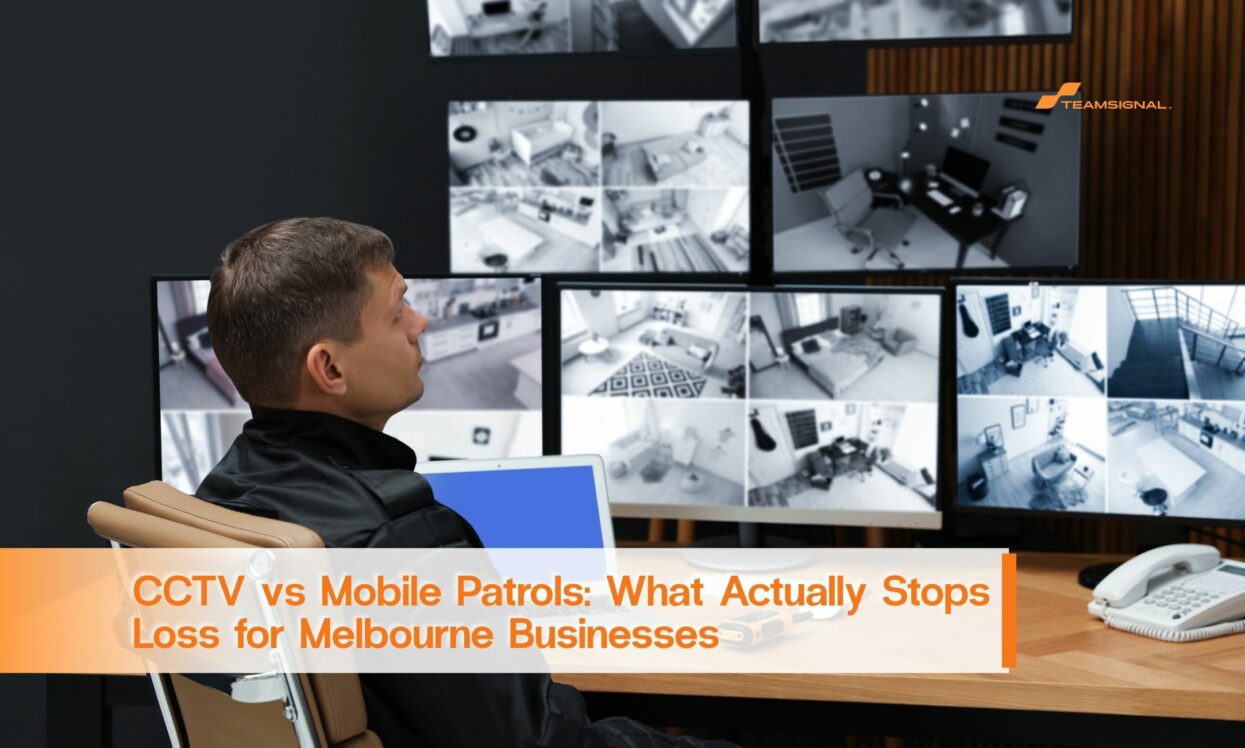
The footage captured what happened. It could not intervene.
Consider a distribution yard experiencing repeated fuel theft from parked trucks. Even with high-definition cameras covering the perimeter, the system may only provide clear footage after each incident. Adding randomised mobile patrols introduces an active and unpredictable presence that cameras alone cannot provide. This illustrative scenario highlights the key difference: CCTV records activity, while patrols can help deter it.
That gap, between recording something and preventing it, is the actual question behind CCTV versus mobile patrols, and it gets skipped in most comparisons that just list features of each. TeamSignal Security is a full service security provider in Australia, and this is one of the most common conversations our team has with operators who already have cameras and are trying to work out what they are actually missing.
CCTV and patrols solve different problems, and conflating them is where most sites end up over-invested in one and exposed on the other.
A camera records continuously. It does not act. Its value is threefold: a documented record for insurance and police after an incident, a passive deterrent to someone who notices it before acting, and, where monitored, the ability to flag movement worth checking on. What a camera cannot do is walk over, check a door, or make a site feel actively watched at 2am rather than passively recorded.
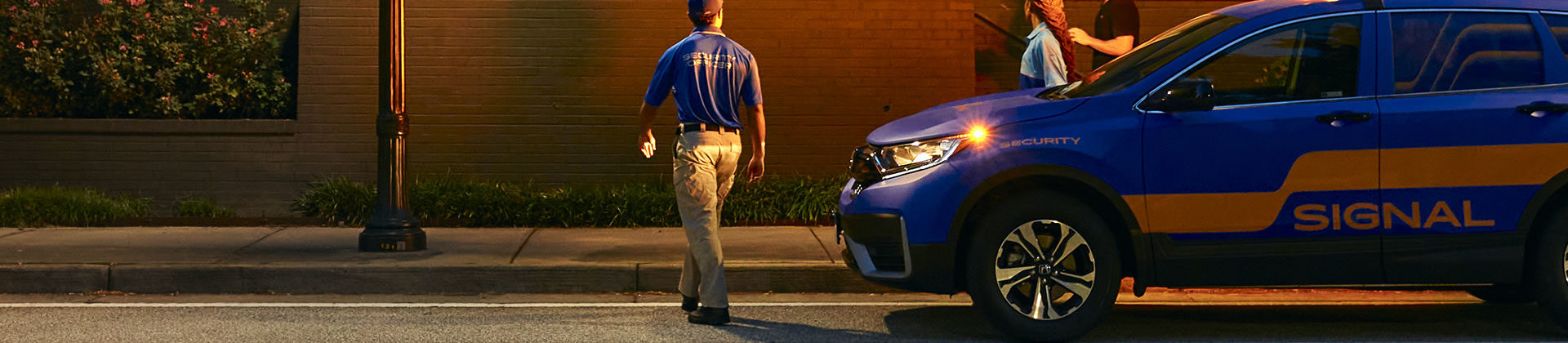
A scheduled mobile patrol is the opposite instrument. It does not build a permanent record of everything, it produces spot checks, timestamped and photographed, at randomised intervals across a risk window. Its value is in unpredictability: a person casing a site can learn where a camera is and avoid its angle. They cannot predict when a patrol vehicle will next arrive. This unpredictability is what gives patrols a stronger active-deterrence role than cameras alone.
The most common mistake is treating CCTV coverage as equivalent to active protection. A camera watching an empty loading dock all night produces a very good video of a theft in progress. It does not stop the theft happening. For sites where the actual goal is preventing loss rather than documenting it afterward, cameras alone are solving the wrong half of the problem.
This is not an argument against CCTV, it is an argument against stopping there. The two genuinely useful roles cameras play, evidentiary record and passive deterrent to the cautious, are real. They are just not the same role a patrol plays, and a site that has invested heavily in the first without the second usually has a coverage gap it does not realise it has until an incident makes it obvious.
"We have CCTV" can mean two very different things, and the gap between them is where a lot of sites overestimate what they actually have.
Most small and mid-sized commercial installations are unmonitored. The system records continuously, and footage is only reviewed once someone reports a problem, a broken window, missing stock, a complaint. This is purely evidentiary. Nobody is watching in real time, which means nobody is alerted while an incident is actually happening. In the illustrative distribution-yard scenario above, the cameras provide useful footage, but only after each theft has already been discovered. Without active monitoring, nobody is alerted while the incident is taking place.
A monitored system has someone, or an automated motion-detection trigger with a human response behind it, actually watching or being alerted while footage is being captured. This closes some of the gap between camera and patrol, since a monitored system can trigger a response while something is happening rather than after. It is also a materially different, usually more expensive, service than a standard installation, and it is worth confirming directly which one a quote is actually describing, since "24/7 CCTV" is sometimes used to describe an unmonitored system that simply never turns off.
Neither monitored nor unmonitored CCTV replicates what a patrol does, since even a monitored camera only ever sees what falls inside its fixed field of view. But the distinction matters enormously when comparing quotes or deciding whether existing coverage is doing more or less than assumed.
Neither is a universal answer. The right weighting depends on what the site actually needs protected and why.
Most commercial and industrial sites in practice need both, in a specific relationship: cameras covering key fixed points, patrols covering the unpredictability cameras cannot provide. Buying more of one to compensate for a gap the other is actually built to fill is a common and expensive mistake.
For most Melbourne commercial and industrial sites, the practical answer is layering rather than choosing: fixed CCTV on entry points and known vulnerable areas, combined with a scheduled mobile patrol across the overnight or after-hours window. The camera captures what happens at the points it watches. The patrol makes the rest of the site unpredictable to anyone testing it.
This combination is usually cheaper than the alternative most sites default to, a dedicated on-site officer, for the same coverage. The security guard cost guide has the full award-rate breakdown, but the short version is that a dedicated officer is paid for every hour of presence regardless of activity, while a patrol bills for scheduled, documented visits across the same window. Layering cameras with patrols typically costs less than either a dedicated officer alone or an oversized camera installation trying to compensate for the absence of any active presence.
Before expanding a camera system or adding a patrol, a genuine audit of what is actually failing is worth doing first, since the answer is not always what it looks like from the office.
A site that keeps adding cameras to a location that has never actually had an incident, while leaving an unmonitored side gate untouched, is solving a problem it does not have and ignoring the one it does.
In the illustrative distribution-yard scenario, installing better cameras would not address the main security gap. The site needs something cameras are not designed to provide: an unpredictable, active presence that makes the property a less attractive target. That is the real distinction between CCTV and mobile patrols, and businesses should identify which function is missing before investing in more of what they already have.
If you want an honest read on whether your site needs more camera coverage, an active patrol, or both, our team can walk the property and tell you plainly. You can see our CCTV and alarm systems or our asset protection services in Melbourne.
Both, but unevenly. A visible camera deters someone cautious enough to notice and avoid it. It does not deter someone who has already decided to act, or who simply avoids the camera’s angle. Its more reliable value is evidentiary, a documented record for insurance and police after an incident, rather than active prevention.
For many overnight commercial sites, a well-run patrol schedule covers the active-deterrence role on its own. What it does not provide is a continuous evidentiary record between visits. If an incident happens between patrol visits, there is no footage of it, only the fact that the last check was clear. Sites with valuable fixed assets at specific points usually benefit from cameras at those points even alongside a patrol schedule.
CCTV and mobile patrols perform different roles. A fixed camera may be noticed, avoided or approached from outside its field of view. A randomised patrol is harder to predict or work around, creating a visible and active security presence across the site. However, the right approach still depends on the property, its risk areas and the times when incidents are most likely to occur.
Start with where actual incidents have happened, not where cameras already point. If incidents cluster in areas already covered by camera but the concern is prevention rather than evidence, a patrol addresses the gap cameras cannot. If the concern is evidentiary, having a clear, documented record for a specific vulnerable point, more camera coverage is the more direct fix.



 1300 893 606