Available Across Victoria – Contact Us Now!

Available Across Victoria – Contact Us Now!
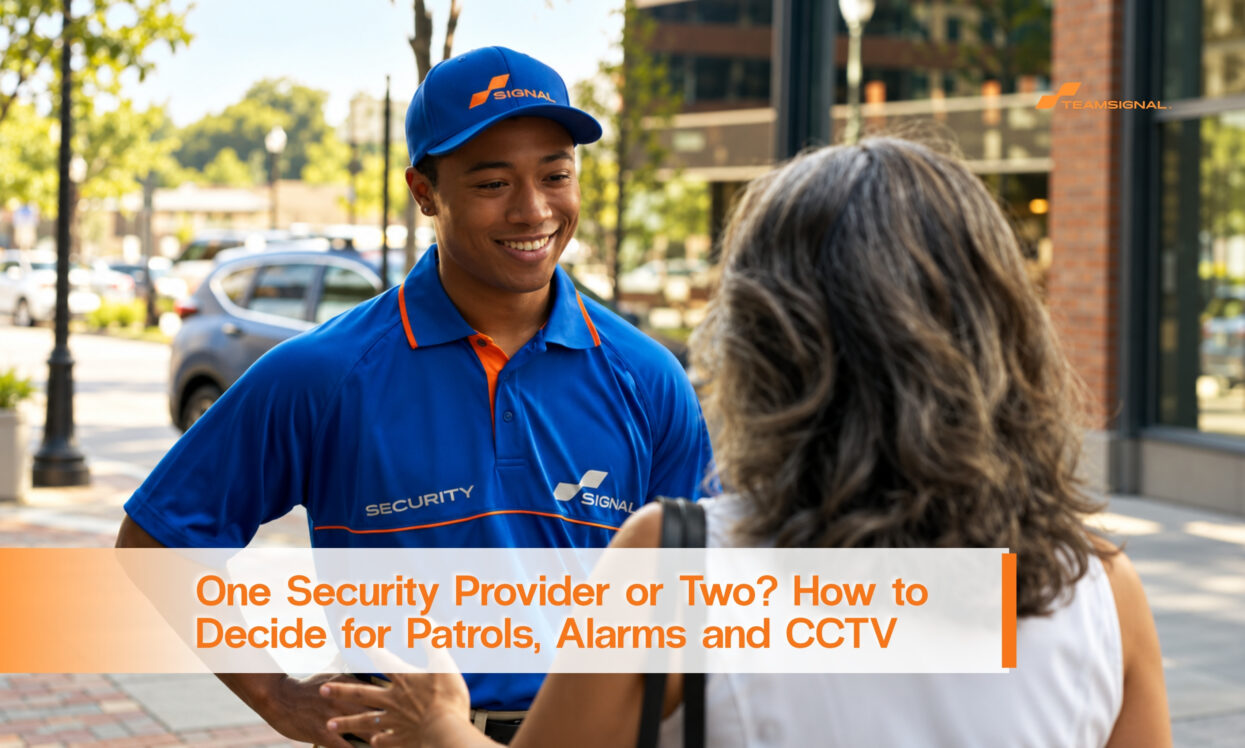
Many Melbourne businesses end up with two security companies without ever deciding to. One installed the alarm years ago. Another was hired later for overnight patrols. Nobody planned it. It just happened.
That setup can work. But it is worth asking whether it is the best one for your site, or just the one you inherited.
We're a full service security provider in Australia, so we have a view on this. We'll give it honestly, including the cases where a split arrangement is the better call.
In a typical split arrangement, one company looks after the electronic side. That means the alarm panel, the sensors and the cameras. A second company runs the physical side, such as patrols or guards.
Each is good at its own job. The question is what happens between them. Who responds when the alarm triggers? Who checks the cameras after an incident? Who do you call when something is not working?
With two companies, you become the link between them. You pass on information, chase updates and work out who is responsible when something goes wrong.
The most common gap is the handover. An alarm triggers, the monitoring company contacts someone, and that someone attends. If the attending officer works for a different company than the one that installed the system, they may not know the layout, the zones or the history.
Another gap is responsibility. Say a camera misses an incident and a patrol also found nothing. Each company can point to the other. You are left with a problem and no clear owner.
A third gap is information. Patrol reports sit with one company and alarm records sit with another. Looking for a pattern, such as repeated activations at the same hour, means piecing together two sets of records.
None of this means split arrangements fail. It means they need more effort from you.
When one company supplies both the physical response and the electronic security, you deal with a single party. That is the main benefit, and it is simple.
For us, it means mobile patrols, alarm response, CCTV and alarm installation sit under one roof. You don't have to coordinate several security providers. Our CCTV and alarm system page explains that CCTV and alarms can be linked with compatible systems for coordinated monitoring, alerts and incident review.
When the same company installs the system and sends the officer, the officer may already be familiar with the site. The people who set up your sensors and the people who attend when they trigger work to the same standards.
You also get one place to raise a problem, instead of several.
Alarm response and patrols are close cousins. Both rely on an officer reaching your site quickly and reporting back.
Our alarm response page says the service can run on its own or form part of a wider plan that includes mobile patrols. When the two are linked, the nearest patrol can attend a triggered alarm. When they are separate, your alarm may wait for a dedicated response team.
Our alarm response page explains how officers attend, inspect and report. It also helps to understand how patrol coverage affects the speed of attendance. A provider with more vehicles already on the road generally has a shorter distance to cover.
That coverage is one reason other security companies use our patrol network to fulfil their own response requirements. It is a sign of how many vehicles are moving through the area, though it doesn't guarantee a specific response time.
A common worry is that using one provider means being stuck with their equipment. That doesn't have to be the case.
We aren't tied to one alarm brand. We can work with a range of systems depending on your site, budget and the functionality you want. The right system for a small office is rarely the right one for a warehouse with several staff entries.
If you want to see how that decision gets made, read our guide to choosing the right CCTV and alarm upgrades. A provider that recommends the same system for every site is selling a default, not a solution.
Cost and coverage matter, but so does the person you call. With a split arrangement, you may have two account contacts, two support lines and two sets of terms.
With one provider, every client has a dedicated account manager. That person understands your site, your requirements and your history. You don't have to repeat yourself each time an issue comes up.
That is especially useful after an incident. Alarm records, patrol reports and any camera footage can be discussed in one conversation instead of three.
Are you running two providers by accident? Five questions will tell you.
Do you know which company attends when your alarm triggers? Can you name one person who is responsible for both your systems and your patrols? Could you pull up patrol reports and alarm records together if an insurer asked? Do your patrol officers know where your sensors and cameras are? If a camera failed tonight, would you know who to call first?
If you answered no to two or more, you probably have a gap. It doesn't mean you must change provider. It may only mean asking your current ones to talk to each other, or writing down who does what.
Most gaps are small and cheap to close once you can see them. Often a single conversation between your providers is enough to fix them. The expensive ones are the ones you only discover after an incident.
We would rather give you the full picture. There are good reasons to keep a split.
If you have a long contract with an alarm company that is working well, switching early may not be worth it. If your site has a specialist system, such as a complex access control platform, a dedicated specialist may suit you. And some sites need a guard on site all the time, which is a different service from patrols and alarms.
There is also a simple case: you are happy. If the patrols are reliable, the alarms work, and both companies respond when called, you may not need to change anything.
The point is not that one provider is always better. It is that the choice should be a decision, not an accident.
Whether you stay split or combine, the same questions help.
Ask who attends when your alarm triggers, and how quickly. Ask who holds the records and whether you can see them in one place. Ask what happens if a camera or sensor fails, and who fixes it. Ask who you call first when something goes wrong.
Ask, too, how you will see what happened. Our article on how technology adds extra security protection shows how digital reporting gives clients visibility of patrol activity.
If the answers are clear and specific, you can trust the arrangement. If the answers are "that's their department", you have found a gap.
If you decide to combine, you don't need to do it all at once. Many businesses start with the part that bothers them most.
You might add patrols to an existing alarm system first, or add electronic security to an existing patrol service. Check contract end dates before you move anything. Ask the new provider to assess what you already have and tell you honestly what can be kept.
A sensible provider will recommend keeping equipment that still works. Replacing everything for the sake of it is not a good sign.
If a provider proposes taking on everything, look at the detail. Ask for the patrol and alarm response terms to be written separately, so you can see what each part costs. Ask what happens to your equipment if you leave. Ask whether the contract lets you change one part without changing the other.
A combined offer should make things simpler for you. If the paperwork is harder to read than two separate contracts, ask why. Clear terms are a good early sign of how the relationship will run.
Putting everything with one company concentrates your dependence on it. If that company has a bad month, both your patrols and your systems feel it. That is a real trade-off.
It also won't fix a poor site layout or a missing lock. Security works best when the basics are sound. A single provider makes coordination easier, but it can't replace good practice on your side.
Having one security provider for patrols, alarms and CCTV simplifies coordination, speeds up information and gives you one person to call. Having two can still be right if you have a good contract in place, a specialist system or a site that needs a guard on hand.
What matters is that you choose deliberately. Look at where the handovers happen, ask who owns each problem, and decide based on your own site. If you want to talk it through, our mobile patrol team can look at what you have now, and you can get a quote for the full picture or just one part of it.
Is it better to use one security company for everything?
Not always. One provider makes coordination simpler, but a good existing contract, a specialist system or a site that needs a guard on hand can justify keeping things separate.
Can I add patrols to an alarm system I already have?
Often yes. Ask the provider to assess your current setup first and tell you what can be kept.
Do I have to use a specific alarm brand?
No. We aren't tied to one brand and can work with a range of systems depending on your site, budget and needs.
Does one provider mean a faster response to alarms?
It can help, particularly when alarm response is linked to patrols and the nearest vehicle can attend. No provider can guarantee an exact response time for every activation.
Who do I contact if something goes wrong?
With one provider, you have a dedicated account manager who knows your site. With two, you may need to contact each company separately.




 1300 893 606