Available Across Victoria – Contact Us Now!

Available Across Victoria – Contact Us Now!
The mirror in the corner does nothing.
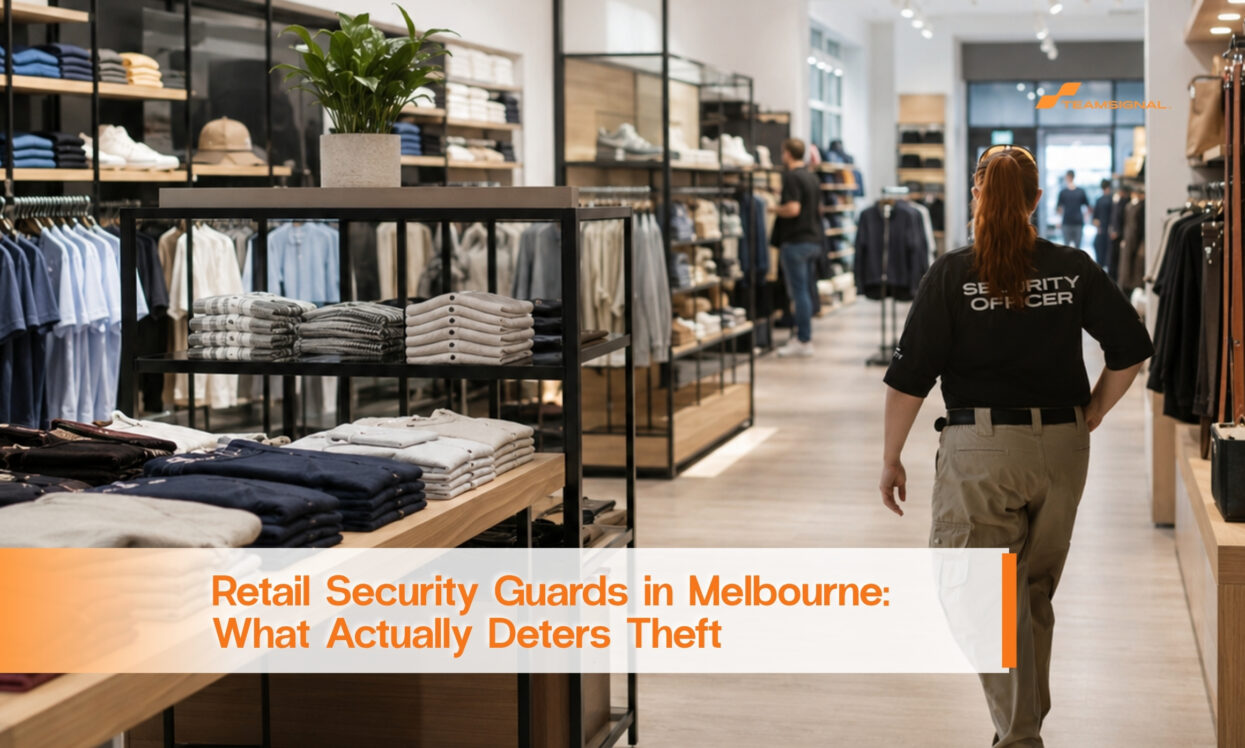
Consider a typical Melbourne homewares store with convex mirrors, a camera above the register and a sensor gate at the entrance. Theft may still occur during busy periods when one staff member is covering both the floor and the register. In this situation, the missing layer is not necessarily more equipment, but a visible person whose role is to remain present, attentive and aware of activity across the store.
That gap, between equipment that looks like security and a presence that actually changes behaviour, is the real question behind hiring a retail security guard. TeamSignal Security is a full service security provider in Australia, and retail is one of the sectors where the difference between the two is most visible in the numbers.
Crime Statistics Agency Victoria recorded 41,547 incidents of theft from a retail store in 2025, up from 39,154 in 2024, a 6.1% increase year on year. This is calendar-year CSA data specifically for the offence category "steal from a retail store," and it continues a multi-year upward trend rather than reflecting a single bad year.
This matters for a simple reason: most retail security setups were designed for a lower baseline than the one stores are currently operating in. A camera and a sensor gate installed several years ago were calibrated against a different level of risk than what the current data shows.
Cameras and sensor gates are detection tools. They record and they alert. What they do not do is make someone reconsider a decision in the moment, because a camera does not look at anyone, it simply exists. A visible, attentive person on the floor does something a fixed piece of equipment cannot: they notice specific behaviour, make eye contact, and change the calculation for someone who was relying on staff being too busy to watch closely.
This is not an argument against cameras, which remain useful for verification and for deterring the more brazen incidents. It is a distinction worth being precise about: equipment documents what happens, a person changes whether it happens at all. A store that has invested in cameras and sensor gates without an active floor presence has usually solved the detection half of the problem and left the prevention half untouched.
Retail theft gets discussed as a stock-loss problem, and the stolen item is the visible part of it. The less visible costs are usually larger over a year.
Every incident that goes unaddressed teaches staff two things: that intervention is not expected of them, and that the store tolerates it. Both outcomes compound. Staff who have watched theft happen repeatedly without consequence tend to disengage from the problem entirely, which widens the gap further. A visible security presence changes this dynamic directly, since staff are no longer the only line of accountability on the floor.
A stolen item at retail price is not a retail-price loss to the business, it is a full-margin loss, since the cost of goods, staff time, and overhead already went into getting that item on the shelf. A store operating on typical retail margins can need to sell several multiples of a stolen item’s value in additional revenue just to offset a single theft, which is why even modest, frequent shrinkage adds up faster than the headline dollar figure suggests.
Not every theft attempt stays passive. Confrontations between staff and someone attempting to leave with unpaid stock carry a real risk of escalation, and untrained staff attempting to intervene without support is a genuine safety concern, not just a loss-prevention one. A trained security presence exists partly to take that specific risk away from retail staff who were never meant to be the ones managing it.
Not every retail site needs a dedicated officer, and the decision should follow the store’s actual pattern rather than a general sense of concern. A guard tends to earn its cost when a store has:
A store without most of these factors may be better served by addressing the specific gap, better sightlines, staff training on approach protocols, before committing to a dedicated floor presence. For a retail store in this situation, the appropriate response may not be a permanent full-time guard. Targeted coverage during identified peak periods may be enough to address the specific gap in the existing security setup.
The value of a guard on a retail floor is not primarily about physical intervention, it is about visible, active attention. A guard should be positioned to see, not just stand, engaging with the space rather than occupying a fixed post near the door. Confirm with any provider what the officer is actually briefed to do: floor presence and customer interaction, fitting room monitoring, high-value area attention, or a combination based on the store’s specific layout and known risk points.
A store in this situation may not need to replace its existing equipment. Instead, it should assess what the equipment is actually achieving and identify the specific periods, sightlines or staffing gaps where the greatest exposure exists. That is the useful starting question for any retail site: not whether more security is needed in general, but which specific gap, sightline, staffing window, or peak period, existing measures are not actually covering.
If you want an honest read on where that gap sits in your store, our team can walk the floor and tell you plainly. You can see our retail security services in Melbourne.
Crime Statistics Agency Victoria recorded 41,547 incidents of theft from a retail store in 2025, up 6.1% from 39,154 in 2024. This continues a multi-year upward trend in the offence category rather than reflecting a single unusual year.
A visible, attentive presence changes behaviour in the moment, since it introduces the possibility of being noticed and challenged. Cameras are valuable for detection and verification after the fact, but they do not, by themselves, change a person’s decision in real time the way active attention from a person can.
No. The decision should follow the store’s specific risk factors: high-value or concealable stock, known blind spots in layout, peak periods where staff coverage thins, and any documented pattern of incidents. A store without these factors may be better served by addressing the specific gap directly rather than committing to full-time floor coverage.
Visible, active attention rather than a fixed post near the entrance. This includes floor presence and customer engagement, monitoring of fitting rooms and high-value areas, and positioning based on the store’s actual layout and known risk points, confirmed directly with the provider rather than assumed.



 1300 893 606