Available Across Victoria – Contact Us Now!

Available Across Victoria – Contact Us Now!
Start with the plan.
To choose an event security company in Melbourne, look at four things. Is there a plan built around your venue and crowd? Does the quote match the numbers the rules set for licensed venues? Do you know how the team will communicate and report on the night? Can you compare the quotes on the same terms? A company that answers all four clearly is worth a closer look.
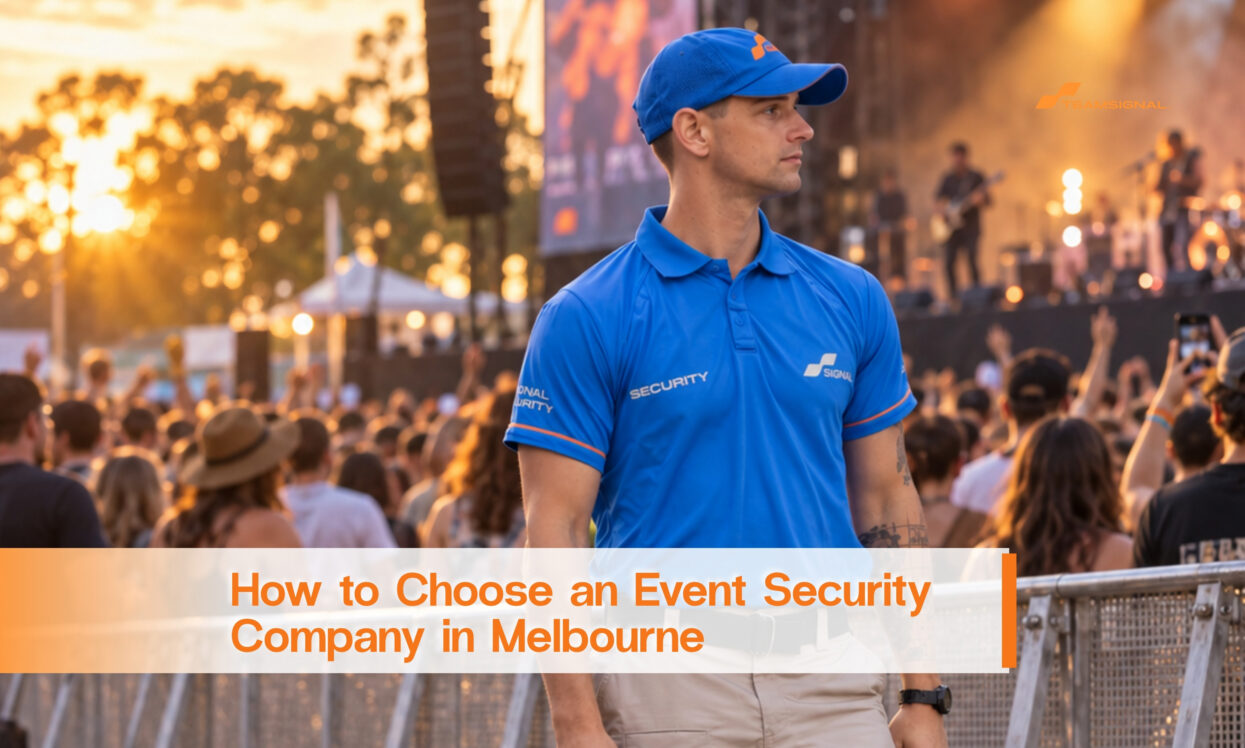
Team Signal Security is a full service security provider in Australia that provides event security for functions, festivals, sporting events and public gatherings. This guide sets out what to ask before you book, so you can compare event security companies on more than price.
A number of guards is an answer to a question nobody has asked yet. The question is what each officer will actually do. At Team Signal Security we start with the venue layout, the expected attendance, the event schedule and the risks, then set officer duties and procedures to suit. You can read how that works on our event security page.
Whoever you talk to, listen for specifics. Where are the entry points? Who watches the restricted areas? What happens when a guest is refused entry? Who does an officer call first when something goes wrong? A plan that fits your event will answer these in your venue's own terms. A generic plan will answer them in general terms.
It also helps to know the roles. Victoria Police lists security guards and crowd controllers as separate licensed activities. A single officer may hold both, but not always. If your event needs crowd controllers, ask the company to confirm that the officers on your roster hold that activity, not only a general guard licence.
Victoria Police regulates the private security industry. Since 19 June 2025, all private security activities in Victoria are licensed activities, and crowd controllers and security guards each fall under that system. A public register of licence holders is available to businesses and individuals.
Where an event serves alcohol under a liquor licence, crowd controllers must be licensed, and the venue must keep a register of the crowd controllers rostered on. Some registrations stay valid during the licence transition, so the register itself is the reference point.
For licensed venues, the Victorian Government publishes a standard crowd controller ratio. It is two crowd controllers for the first 100 customers, plus one more for every additional 100 customers or part of 100. For 240 customers, that means four. Your liquor licence conditions state whether you need crowd controllers at all, and may add instructions about where they stand and what they watch.
If your quote has fewer officers than the ratio for your guest count, ask why. Our guide to what event security in Melbourne requires covers the ratio, licence conditions and what to give a provider when booking.
If your event is on a road, reserve, park or other public land in the City of Melbourne, you need an event permit. The permit process expects adequate public liability insurance. The City of Melbourne's own information says small activities need one to two weeks notice, while large events can need six to twelve months. Whether you need a liquor licence or permit depends on how alcohol is sold or supplied, not simply whether guests will drink it. Selling alcohol or including it in the ticket price generally requires a licence or permit. Free alcohol and BYO arrangements have their own conditions, so check with Liquor Control Victoria which requirements apply to your event.
None of that is the security company's job. It does affect your timeline, though. Fix the date, the site and the approvals first. Then book security around real numbers. A late booking with a guessed guest count is the usual cause of a rushed quote and a thin plan.
A good plan needs good information. The more you send early, the closer the quote will be to the real job. Gather these before you ask for prices.
Send the venue address and a site map if you have one. Send the date, the start and finish times, and the load in and pack down times. Tell them how many guests you expect and whether alcohol will be served. List any areas that must stay restricted, such as a green room, a cash point or a storage area. Name the person who will be your contact on the day, with a mobile number that will be answered.
If you hold a risk plan for the event, share it. If you do not, say so. A provider who knows what you have already thought about can fill the gaps instead of repeating your work.
Also say what has gone wrong at past events. If a side gate was propped open last year, or guests queued onto a footpath, tell the provider. That kind of detail shapes a plan better than any template.
| Question to ask | A good answer | A weak answer |
| Which licensed activities will the officers hold? | A clear answer, matched to the roles on your roster | A vague answer, or the same answer for every role |
| How will you plan for my venue? | Review of layout, attendance, schedule and risks first | A standard package for every event |
| How many officers, and why? | A number tied to your guest count and the venue's rules | A round number with no reasoning |
| Who is in charge on the night? | A named contact, with a clear way to reach them | "Someone from the roster" |
| What happens if something goes wrong? | A set escalation path and an incident report afterwards | "We will handle it" |
| What is in the quote? | Hours, officer numbers and roles written out | One total with no breakdown |
Print this table and take it into every conversation. The answers matter, but so does the way they are given. A company that explains its reasoning in plain words is usually one that has done the work.
Two quotes that look alike can describe very different events. One may include more officers or longer hours. The other may leave out the planning visit. Ask each company to quote for the same start time, the same finish time, the same number of officers and the same duties. Our guide to what happens when you ask for a security quote shows what a proper quote process looks like.
The cheaper quote is not always the weaker one. A low number deserves a question, though. Officer pay follows the industry award, and a price that sits far below the usual cost of hours worked is hard to explain. We break the mechanics down in our guide to what security guards cost in Melbourne.
Event security work usually covers entry management, crowd observation, restricted areas and incident response. Officers also coordinate with event staff and report back to the organiser. Our event personnel can support each of these, depending on the event.
Here is a simple illustration, not a client case. Take a 240 guest function with alcohol, which needs four crowd controllers under the standard ratio. One might hold the main entrance and check guests in. A second might stand at the bar area. A third might watch a restricted room and the rear exit. The fourth might move through the room and the car park, ready to step in. The exact split depends on your venue. What matters is that every officer has a named job and every job has an officer.
Before doors open, a good provider briefs the officers on the layout, the schedule and the escalation path. During the event, they stay in contact with you. Afterwards, they report any incident in writing. If your provider cannot describe those three stages, keep asking.
Not every gathering needs a security company. A small private function with no alcohol sold, a trusted guest list and a venue that already provides its own staff may not. If your venue's licence requires crowd controllers, you do need them.
Event security is also not a substitute for approvals. Closing a road involves notifying Victoria Police and the council. Event security does not cover that, and a security company cannot sign it off for you. We would rather tell you that early than sell you a service that does not solve the problem.
Events leave sites exposed before and after the crowd. Equipment arrives early. Stock and stages sit overnight. Mobile patrol services can check the venue between event days, and our wider event security services can be planned alongside them.
We cover events across Eastern Melbourne, South East Melbourne and Frankston and the Mornington Peninsula. Give us the venue, the date and the expected crowd, and we will tell you what we would recommend.
Ask how the plan fits your venue. Test the numbers against the rules. Compare quotes on the same terms. Team Signal Security will walk you through each step, and will tell you plainly if the event does not need as much as you were quoted.
How do I hire event security in Melbourne?
Confirm the date, venue, expected guest numbers and any permits first. Then ask two or three event security companies to quote for the same hours, officers and duties, and ask how each quote matches the licensing rules for your venue.
What does an event security company do?
It supports entry management, crowd observation, restricted areas and incident response, and it coordinates with the organiser and venue staff. The exact duties depend on the event and the venue.
How many crowd controllers do I need for my event?
For licensed venues, the standard is two for the first 100 customers, plus one for each extra 100 or part of 100. So 150 guests need three, and 240 need four. Your liquor licence conditions set the final requirement.
Do event security officers need a licence in Victoria?
Yes. All private security activities in Victoria are licensed, and crowd controllers at licensed venues must be licensed. Victoria Police keeps a public register of licence holders.
Victoria Police, Private security: licensing and regulation, the 19 June 2025 changes and the public register.
Victorian Government, Security in licensed venues: crowd controller licensing, the standard ratio and the register of crowd controllers.
Australian Business Licence and Information Service, Permit to conduct an event on public land, City of Melbourne: public liability insurance, approval times and liquor licence notes.
Service descriptions come from the Team Signal Security event security pages.


 1300 893 606