Available Across Victoria – Contact Us Now!

Available Across Victoria – Contact Us Now!
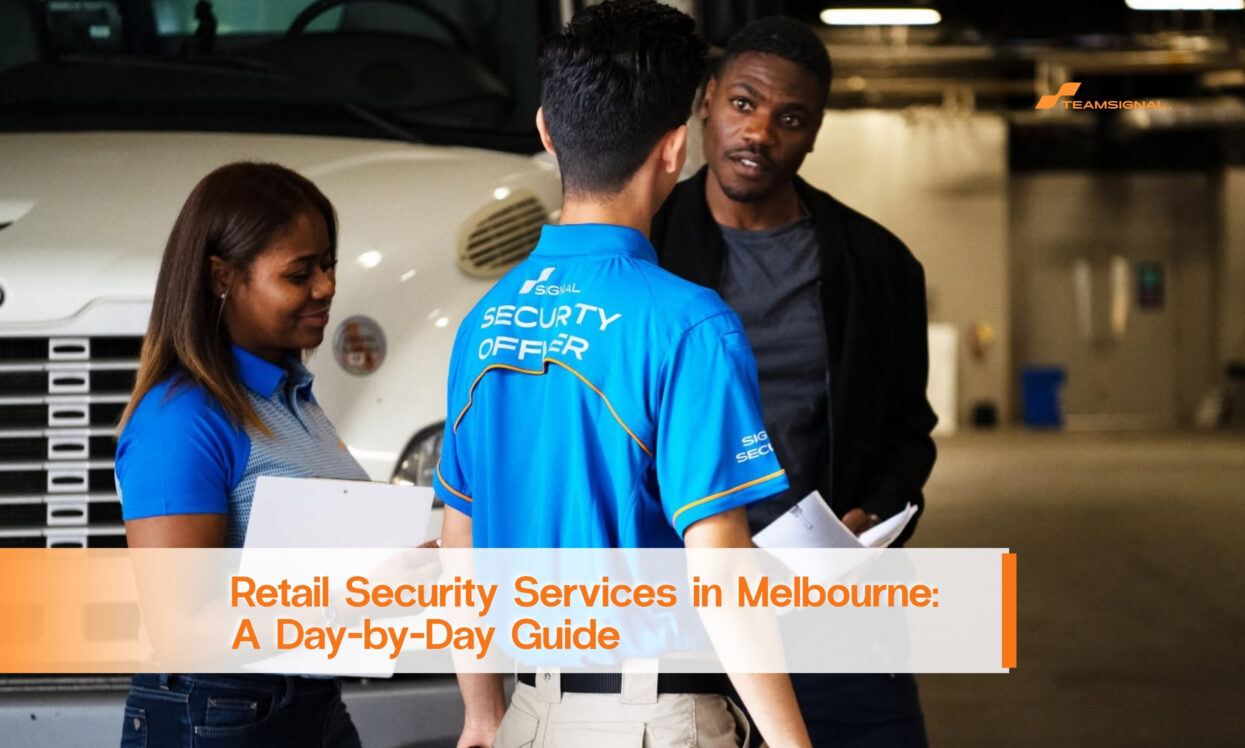
A shop faces different risks at different times of day.
A retail security service covers a store through its whole day: opening, trading, closing and the hours overnight. Each stage has its own risks and its own fixes. Some are handled by layout and staff. Others are where a security provider adds real value. Team Signal Security is a full service security provider in Australia that supports retail sites from the shop floor to the loading dock and after-hours patrols.
This guide walks through a retail day in four stages. For each one, it shows what Victoria Police advises, what your own team can do, and where a service helps.
Start with the numbers. Crime Statistics Agency Victoria released its figures for the year ending 30 June 2026. It recorded 21,306 shoplifting incidents with an alleged offender, up 9.3 per cent. Property crime fell overall, with fewer burglary and other theft offences, but shoplifting went the other way.
Staff feel it on the floor. In a December 2025 survey of close to 3,000 retail, fast food and warehouse workers, the SDA union found that 88 per cent had faced verbal abuse in the past 12 months and 25 per cent had faced physical violence. The union says the physical violence figure is double its 2023 result. It is a union survey of its own members, so read it as a signal from the shop floor, not a count of every shop.
Both sources are statewide or national, so they are not a forecast for your street. They do explain why trading hours, not only overnight hours, deserve a plan.
| Stage | Main risk | What layout and staff handle | What a service adds |
| Opening | Unlocking alone, deliveries, a rushed start | A set opening routine, two staff where possible | Opening support and a perimeter check |
| Trading | Theft, aggressive customers, crowded peaks | Sightlines, engaged staff, tidy displays | A visible officer on busy days and incident support |
| Closing | Cash, staff leaving late, someone left inside | Lock-up checklist, cash in the safe | Closing support, escorts, and checks of stockrooms |
| Overnight | Break-in, damage, alarm activations | Locks, lighting, monitored alarm and CCTV | Mobile patrols and alarm response |
The start of the day is easy to overlook. A staff member often arrives first, unlocks the door and walks into a dark store. Deliveries may arrive while the shop is still being set up.
Victoria Police advises that you roster at least two staff per shift where possible, so the store is never left unattended. For opening, it also means the person who unlocks is not alone.
A security service can add a perimeter check before staff enter, and help with the opening routine at sites that are targeted often. Our retail security service includes opening and closing support, and patrols of car parks and loading areas.
Deliveries deserve a plan of their own. Keep the loading door locked between drops, check who is at the door before you open it, and do not leave stock outside. A short opening checklist, kept at the back door, helps a new team member follow the same steps as everyone else.
During trading, most of the work is done by layout and people. Police advice is practical. Greet customers, watch for odd behaviour, train staff and keep sightlines clear.
The same guidance covers products. Put high-risk items such as alcohol where staff can see them, use tags or locked displays, and keep portable, expensive items away from exits. Mirrors, good lighting and clear shopfront windows also help.
Good stock handling helps too. Remove empty hangers and excess stock from shelves and racks, so a gap is easy to spot. Check the number of items going into and out of fitting rooms. Staff who greet each customer make it harder for anyone to browse unseen.
Where does a security service fit? Mostly at peak times and on bad days. A store may be fine on a quiet Tuesday and stretched on a Saturday or during a sale. A visible officer on those days gives staff support and lets customers see that someone is watching.
We cover the deterrence side in detail in our article on retail security guards in Melbourne. Here, the point is timing. Add cover when the risk is highest, not all week.
Not every problem is theft. Sometimes a customer becomes angry or threatening. Victoria Police advises staff to stay calm, listen, offer solutions and call for help. Only one person should talk to the customer. If the person will not leave, staff can tell them to go and advise that they are trespassing. They should not force the person out.
The same page says duress or panic alarms work best when they can be set off discreetly, for example with a button near the cash drawer or one pressed with a foot or knee. Staff who are not involved should call for security or police.
This is where an on-site officer earns their place. They give staff someone to call, and they can take over when a conversation is going nowhere. Without one, staff are left to manage it alone until help arrives.
Escalation should be written down. Staff should know who to call, what to say and what to avoid. A short card by the till, listing the steps and the numbers, is more use in the moment than a long policy folder.
Closing time combines cash, tired staff and an empty street. Victoria Police advises that you limit the cash kept on site, never leave a register unattended, and avoid counting cash in front of customers or following a predictable banking routine.
The Police theft guide also asks you to check that all doors are locked and that no one remains inside after closing. A written lock-up checklist makes this routine.
A security service can support closing in three ways. An officer can check stockrooms and back doors, and walk staff to their cars. At sites that move cash, an officer can also escort staff who are carrying it.
Closing is also when a quiet check pays off. Walk the store and look in the fitting rooms, the toilets, the stockroom and behind displays. A staff member who closes alone should tell someone when they leave and when they arrive home. These steps cost nothing.
After closing, the shop depends on its physical protection. Victoria Police advises quality locks and doors, good lighting, monitored alarms and entry alert systems, and CCTV that covers entrances, exits and checkout areas. It also advises signs that show CCTV is in use.
Make sure staff know how to save and hand over CCTV footage if police ask for it. If you need to add or replace a system, see our CCTV and alarm system service.
Alarms and cameras tell you something happened. Someone still has to go and look. That is the role of mobile patrols and alarm response. Our guide to what happens when your business alarm goes off explains the steps from alert to attendance.
If you are choosing a type of alarm, see monitored alarms versus DIY app alarms and wired versus wireless alarm systems.
Patrol timing should follow your risk. A store near a late-night strip may want visits around closing and again in the early hours. A store in a quiet industrial estate may be better served by random visits. The goal is to avoid a pattern that anyone can learn.
These are illustrations, not client cases.
A bottle shop in a suburban strip trades until 9pm. It has one staff member after 6pm and a till near the door. The biggest risks are theft at the front, abusive customers and cash at closing. A visible officer on Friday and Saturday evenings, a discreet duress button and a two person close would address all three. Overnight, a monitored alarm and one patrol visit would do.
A homewares store in a shopping centre has a stockroom, a loading dock and a team of eight. Most risk sits in deliveries, the dock and late exits. An officer for opening, dock checks and closing may help more than a floor guard. Overnight, the centre may already cover common areas. Check before you pay twice.
Not every shop needs one. A small store with two staff, clear sightlines and low value stock may be well served by good layout, a monitored alarm and a camera system. A single patrol visit after hours might be all it needs.
A security service also cannot fix a poor layout. If a high-risk shelf is out of sight, move the shelf. If staff are not trained to greet and watch, train them. Then see what risk is left. That is the part to pay a provider to cover.
Ask for the plan, not just the price. A good provider will walk the site and ask about trading hours, layout, deliveries and past incidents. They should explain how officers, patrols and alarm response fit together.
Hiring floor officers also brings a legal step. From 1 December 2026, Victoria Police says, a shop that engages a licensed guard must prepare a risk management plan for unarmed security guard work first. Your provider needs the plan at least a day before the officers start. Ask how they will handle it, and what they need to know about your store.
Ask how quotes are built before you compare them. Our guide on what happens when you ask for a security quote explains the steps. If you are weighing a single provider against several, read one security provider or two.
We work with retailers across eastern Melbourne and south east Melbourne, and we adjust cover around opening and closing, deliveries, promotions and busy days.
A retail day has four stages, and each has its own risk. Layout and staff handle much of it. A service adds most when it is timed to the hardest moments: busy trade, closing, and the long hours overnight. Start with the basics, then add cover where a gap remains.
What are retail security solutions?
Retail security solutions are the mix of store layout, trained staff, cameras, alarms, security officers and patrols that protect a shop. The right mix depends on trading hours, layout and the risks you face.
What does a retail security service do?
It can provide uniformed officers on the floor, entrance monitoring, opening and closing support, stockroom checks, patrols of car parks and loading areas, incident reporting, and mobile patrol and alarm response after hours.
How do I choose between retail security companies?
Look for a provider that walks your site, asks about your trading pattern and explains how officers, patrols and alarm response work together. Ask how incidents are reported to you.
Is a retail security service worth it for a small shop?
Sometimes. A small shop with clear sightlines and two staff may need only a monitored alarm, cameras and a patrol visit. A service pays off most where there are busy peaks, cash at closing or a history of incidents.
Crime Statistics Agency Victoria, Media release: Property crime continues to decline (year ending 30 June 2026; accessed 5 November 2026).
SDA, Customer abuse and violence 2025 reports (published 5 December 2025; accessed 5 November 2026).
Victoria Police, Preventing shoplifting (page updated 10 September 2026; accessed 5 November 2026).
Victoria Police, Respond to aggressive customers (page updated 17 April 2026; accessed 5 November 2026).
Victoria Police, Risk management plans for security services (accessed 5 November 2026).


 1300 893 606