Available Across Victoria – Contact Us Now!

Available Across Victoria – Contact Us Now!
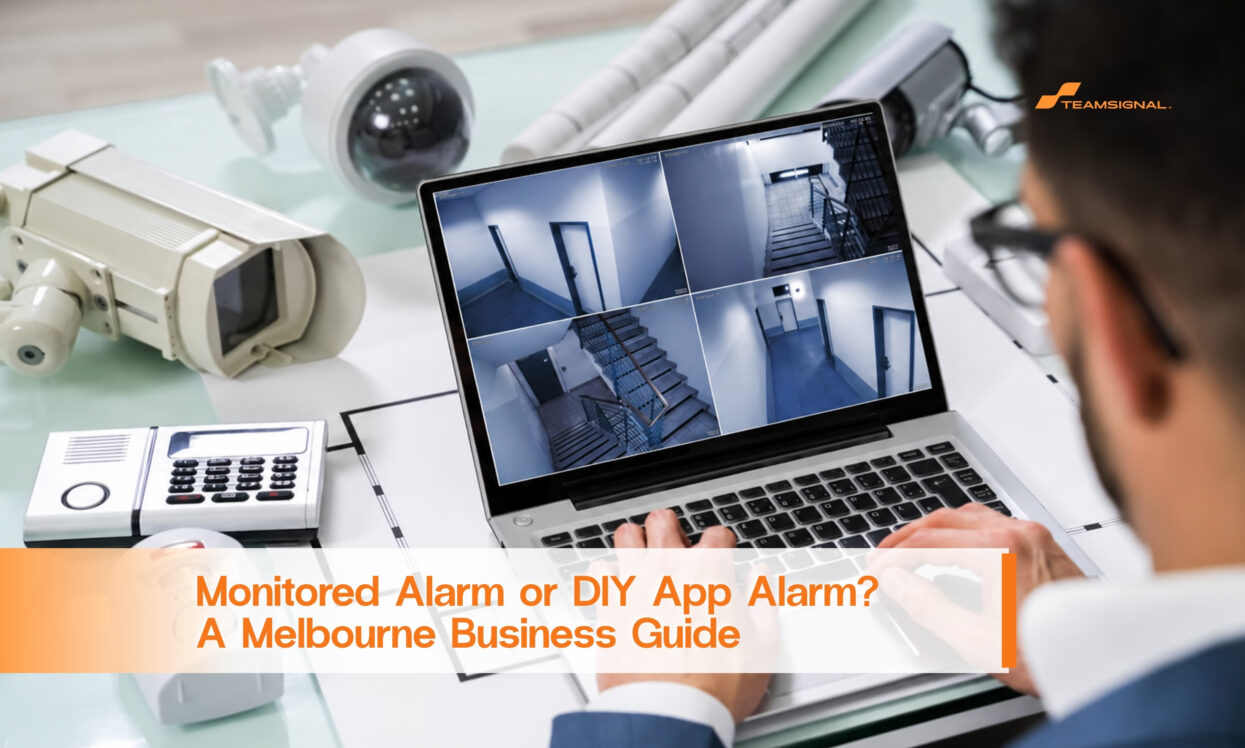
A DIY alarm is easy to buy. You open a box, pair a few sensors, download an app and your phone buzzes when a door opens. For a spare room or a home office, that can be enough.
A business site is different. It holds stock, tools, records and equipment. If the alarm goes off at 2am, the real question is not "did my phone buzz?" It is "who is on the way?"
We're a full service security provider in Australia, and this guide compares DIY app alarms with monitored alarms so you can decide which suits your site. Both have a place. The right choice depends on what you are protecting and who can act when it triggers.
A DIY system is usually bought online or from a hardware store and set up by the owner. Sensors on doors and windows talk to a hub. The hub sends a notification to your phone, and often sounds a siren.
The good parts are real. It costs less to start, it is quick to set up and the apps are simple. You can arm and disarm from anywhere and see a log of events.
The limit is built into the design. The alert goes to you, and you are the response. If your phone is on silent, you are asleep, you are overseas or you have no signal, the alert waits.
A monitored alarm is connected to a professional monitoring centre. When a sensor triggers, the signal goes to trained operators. They follow a set process: check the type of alert, contact keyholders and, where it is warranted, send a response team to attend.
That last step is the key difference. The system does not rely on one person seeing one notification. It relies on a process that runs at any hour.
Our guide on what happens when your business alarm goes off walks through how an alert is classified and what follows.
Use these questions to compare the two options for your own business.
Who would see the alert at 2am? If the answer is "me, if I wake up", a DIY system leaves a gap.
Who can get to the site fast? Owners often live far from the premises. A monitored system can send someone who is closer.
What is inside? Stock, tools, vehicles and records raise the cost of a loss. The more valuable the contents, the more it matters that someone acts.
Does your insurer have a view? Some policies reward or require monitoring. Check yours, and ask your broker before you decide.
How often does the site sit empty? Sites that are empty overnight, on weekends and over holidays have the most to gain from monitoring.
When a monitored alarm leads to a response, there are industry requirements for how fast an officer should attend. They are commonly set at 90 minutes on weekdays from 6am to 6pm, on weekends and on public holidays, and 45 minutes from 6pm to 6am.
These are industry requirements, not guarantees for any single event. A provider's own coverage and vehicle positions often allow quicker attendance, and the aim is always to attend sooner where possible. Our guide on alarm response explains how this works across Melbourne.
A DIY system can be a fair choice in some cases:
Even then, treat it as one layer. Victoria Police recommends a monitored alarm and cameras among its tips for business premises, along with good locks and lighting.
The upfront price is only part of the cost.
Your time. Setting up sensors, testing them and fixing faults takes time away from running the business.
Battery and fault checks. Wireless sensors rely on batteries. Someone must check them. A dead sensor looks the same as a quiet night.
Coverage gaps. It is easy to protect the front door and forget the roller door, skylight or side window. A site walk-through usually finds these.
False alarms. A poorly placed sensor can trigger on a cat, a draught or a hanging banner. Repeated false alerts lead people to ignore them. Our guide on why alarms keep false-triggering covers common causes and fixes.
App alarms and cameras connect to your internet. That brings a small cyber risk. The Australian Cyber Security Centre's advice on internet-connected devices is simple. Change default passwords, apply updates and keep devices on a separate network where you can.
This applies to any connected system, DIY or professional. A professional installer will normally set this up as part of the job, but it is worth asking.
A monitored service is only as good as the equipment behind it. Modern systems can report faults, tell you when a sensor battery is low and link with cameras so an operator sees what triggered the alert.
Some systems also combine alarm and access control, so you can see who armed or disarmed the site and when. Others focus on simple, app-based daily use. The right match depends on the site, the number of users and the budget, not on one brand being better than another.
Yes, but plan for it. Some DIY hubs cannot connect to a monitoring centre, so an upgrade may mean replacing equipment, not adding a service. If you expect to monitor later, ask before you buy whether the equipment can be monitored.
It can also help to place sensors in the same spots a professional would. That makes the later switch cheaper. A short site assessment before you start can save money in the long run.
Monitoring is not a force field. An alarm detects and reports. It does not stop a determined offender on its own, and a response team still needs time to travel.
That is why a good plan has layers: locks that work, lighting, cameras, a monitored alarm and, for many sites, regular mobile patrols. Each layer covers a gap the others leave.
Ask yourself one question: "If this alarm goes off at 2am on a public holiday, what happens next?"
If the honest answer is "I find out in the morning", you have a gap. If the answer is "an operator checks it, calls the keyholders and a response team attends", you have a process.
If you lean towards monitoring, a few questions help you compare offers.
What happens when an alarm triggers, step by step? Who is called first, and in what order? How are keyholders contacted, and how are updates recorded? Is there a response service included, or does it need a separate arrangement? How does the provider confirm that your system is still reporting properly? Who is your point of contact when something needs to change?
A clear, plain answer to each is a good sign. Vague answers are worth probing.
Every monitored system needs a current keyholder list. These are the people the operator calls when an alarm triggers and who can attend or give access if needed.
Keep the list short, correct and in the right order. Add mobile numbers, not just office lines. Update it when staff change roles or leave. An out-of-date list slows everything down, and it is one of the simplest things to fix.
Whatever you choose, test it. A monitored system should be tested regularly with the provider, so you know signals arrive. A DIY system should be tested monthly: open each door, walk past each sensor and confirm the app alerts you.
A regular service visit, at least once a year, is a sensible baseline for any alarm.
Picture a small trade supplier with a unit and a stock room. The owner fits a DIY alarm and gets a notification at 1.40am, but is asleep. The alert sits unread until 6am.
If the same unit had a monitored alarm, the signal would have gone to an operator at 1.40am, and they would have called keyholders and arranged for a response team to attend.
This is an illustration, not a client story.
Choosing a system is easier with one point of contact. At TeamSignal Security, every client has a dedicated account manager who knows the site, the contacts and the history. That means you explain your site once, not every time you call.
A DIY app alarm tells you something happened. A monitored alarm makes sure someone acts on it. For a business site that holds valuable contents or sits empty for long periods, monitoring is usually the stronger choice. For a small, low-risk space, a DIY system can be a sensible start.
If you want help comparing options for your site, you can talk to our CCTV and alarm team or get a quote.
What is the difference between a monitored alarm and a DIY alarm?
A DIY alarm sends an alert to your phone. A monitored alarm sends a signal to a monitoring centre, where operators follow a process that can include calling keyholders and sending a response team.
Is a DIY alarm good enough for a small business?
It can suit a very small, low-value or temporary space. For sites with valuable stock or long empty periods, monitoring usually gives stronger protection.
Can I add monitoring to a DIY alarm later?
Sometimes. Some DIY hubs cannot connect to a monitoring centre, so check before you buy.
How fast will someone respond to a monitored alarm?
Industry requirements are commonly 90 minutes on weekdays from 6am to 6pm, weekends and public holidays, and 45 minutes overnight. These are targets, not guarantees, and a provider aims to attend sooner where possible.
Will a monitored alarm lower my insurance?
It may help, but it depends on your insurer. Ask your broker.



 1300 893 606