Available Across Victoria – Contact Us Now!

Available Across Victoria – Contact Us Now!
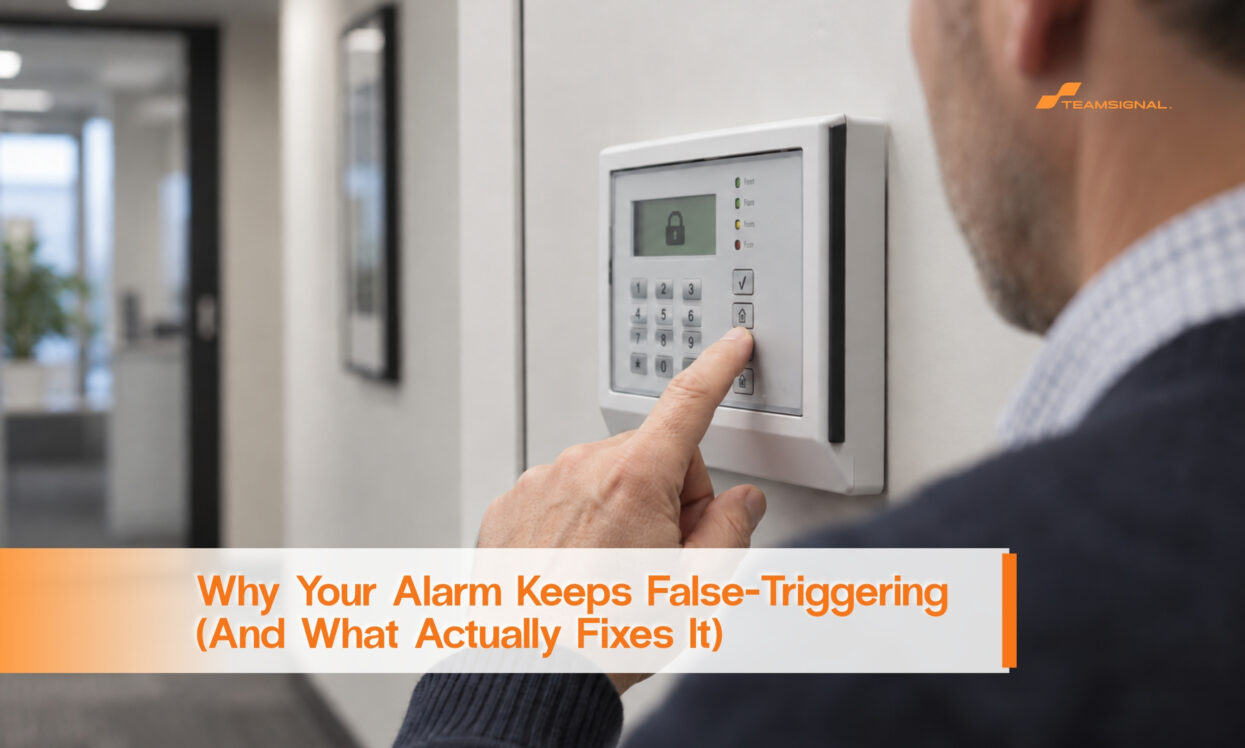
The alarm went off at 2am. Again.
By the fourth call in a month, the business owner had started doing something dangerous. He was silencing it from his phone before checking what triggered it. That's the real cost of a false alarm problem. It isn't just the callout fee or the broken sleep. It's what happens the one time the alarm is actually right, and nobody takes it seriously anymore.
We're a full service security provider in Australia. False alarm callouts are one of the most common complaints we hear from clients switching providers. Most of the time, the fix isn't a new system. It's finding the actual cause, and that cause usually isn't what the business owner assumed.
A false trigger almost never comes from nowhere. It comes from something specific. Most causes fall into a handful of categories we see again and again.
Motion sensors placed too close to air vents or heaters can trigger on temperature change alone. The sensor mistakes a blast of warm air for movement. Sensors aimed across a room with hanging decorations, balloons, or a loose curtain can pick up movement that has nothing to do with an intruder. Door and window contacts loosen slightly over time. A gust of wind rattling the frame can be enough to set one off. Ageing backup batteries cause problems too. The kind installed years ago and never checked can make a system behave erratically as they degrade, long before they fail outright.
None of these causes are dramatic. That’s exactly why they get missed. A business owner assumes a false trigger is random. They reset the system and move on. Nobody actually investigates what caused it.
Resetting an alarm after a false trigger clears the immediate alert. It does nothing about the underlying cause. A sensor near a heating vent that triggered once will trigger again the next time that heater runs. A degrading battery keeps degrading. The pattern repeats until someone actually diagnoses it. Every repeat costs a callout fee, a disrupted night, and a small erosion of trust in the system itself.
We've taken over monitoring for sites that racked up a dozen false triggers in a single quarter. All of them got reset the same way, every time. Nobody ever traced the actual fault. The business had started treating every alert as noise. That's the outcome we're most trying to prevent. It's exactly the outcome that turns a real break-in into a missed one.
Fixing a false-alarm pattern takes more than swapping a battery and hoping for the best. Our CCTV and alarm technicians work through a structured check when a client reports repeated triggers:
That event log review matters more than anything else on this list. Most systems record exactly which zone triggered and when. Very few businesses ever look at it. It’s usually the fastest way to find the actual cause instead of guessing at one.
Backup batteries typically need replacing every three to five years. Very few standard maintenance visits actually load-test them properly. A quick visual check can show a battery as fine when it's actually failing. So can a basic voltage reading taken with no load on it. Those real conditions are exactly when the battery needs to work, during a mains power outage. We test batteries under load specifically because that's the only way to know whether they'll hold up when the power genuinely drops out. That's usually the moment they're needed most.
A degrading battery doesn’t always fail cleanly. It often causes intermittent, hard-to-explain faults first. That’s exactly the kind of false trigger that gets blamed on something else entirely.
A camera on its own doesn't stop a false trigger. But a camera linked to an alarm can cut down on false callouts a lot. It lets a monitoring operator check what actually caused an alert. That check happens before anyone gets sent out. If a camera shows a curtain moving in the wind, not a person, that's a callout avoided entirely. Queensland Police recommend exactly this kind of layered approach. Cameras, alarms, and access control should work together. No single measure should carry the whole job. We've found the same holds true across the sites we manage in Melbourne. For a wider look at what a well-placed camera system adds beyond just recording, see our overview of the key benefits of CCTV surveillance for businesses.
This is also where an older system becomes a real limit worth naming honestly. An alarm system installed a decade ago has no camera link and no way to check an alert visually. It will always cause more false callouts than a modern, linked system. Upgrading isn't always needed. But for a site with a repeat false-alarm problem, it's worth weighing against the ongoing cost of those callouts.
An older, non-integrated alarm system will always generate more false-positive callouts than a modern, camera-linked one. Upgrading is not always necessary, but the comparison is worth making for a site with a repeat problem.
Most false-alarm conversations start with the callout cost. That's rarely the biggest expense. Monitoring firms, and sometimes local authorities, can flag a site with a pattern of repeat false alarms. Some council and provider agreements add extra fees after a set number of false triggers. Some even drop that site to a lower response priority. A site with a fault left unfixed can pay more in fees over a year than the cost of a proper check would have cost up front.
A single-tenant office can usually trace a false-alarm pattern back to one cause fairly quickly. A shared building, a strata complex, or a shopping strip with multiple tenants is harder. Different businesses come and go at different hours. A cleaner working late might trip a sensor nobody expects active at that time. A shared loading dock might see deliveries that trigger a zone meant to be quiet overnight.
We treat these sites differently from the start. Rather than diagnosing one sensor in isolation, we map the whole building's activity pattern, tenant by tenant, before recommending a fix. A shared-site false alarm is rarely one tenant's fault alone. It's usually a system built around assumptions that stopped matching how the building actually gets used.
If your site has had more than two or three false triggers in the past few months, treat that as a signal, not a nuisance. We'd rather diagnose the actual cause in one visit than have your team keep resetting the same fault every few weeks. Ask your current provider for the event log from the last few triggers. If they can't produce it, or haven't looked at it, that tells you something worth noticing. Many of our facilities clients pair a proper diagnostic with our mobile patrol service, since a patrol visit can confirm what a camera alone can't always resolve on site.
You don't need special tools to spot a false alarm pattern early. A basic log kept on a shared spreadsheet can do most of the work. Note the date, the time, the zone that triggered, and the weather that day. Wind, heavy rain, and sudden temperature swings show up in this kind of log far more often than most people expect.
After a month or two, a pattern usually becomes obvious. Maybe every trigger happens on a windy night. Maybe they all cluster around the same sensor near the loading dock. That simple record makes the diagnostic visit faster too, since the technician isn't starting from zero. They're confirming a pattern you've already half-solved yourself.
A single false trigger, on its own, usually isn’t worth a callout. Weather, a stray moth near a sensor, or a one-off gust of wind can explain most single events. The line to watch is repetition. Two or more triggers from the same zone within a month is worth a proper look. So is any trigger during a storm. Water getting into a sensor housing is a common, overlooked cause. It gets worse each time it happens.
We'd always rather get a call about a pattern early. The alternative is a client quietly resetting the same fault for six months before finally asking for help. By then, a simple sensor fix can turn into a full panel replacement. The cost difference is large.
A false alarm pattern is almost always fixable. It's rarely the mystery it seems like at 2am. Most causes trace back to sensor placement, an ageing battery, or a system with no way to visually confirm what actually triggered it. Fixing the real cause costs less over a year than repeatedly paying for callouts to reset a fault nobody's diagnosed.
If your alarm system has been triggering more than it should, we can run a proper diagnostic rather than another reset. Get a quote built around fixing the actual fault, not just responding to the next callout.
More than two or three in a few months usually points to an identifiable cause rather than bad luck. At that point, a proper diagnostic is worth doing rather than continuing to reset the system after each trigger.
In some areas, a documented history of false alarms can affect how a site’s alerts are treated by monitoring providers or local authorities. This sometimes comes with reduced priority or added fees. Fixing the underlying fault avoids this building up over time.
Backup batteries typically need replacing every three to five years. They should be load-tested at each maintenance visit, not just visually checked. A battery can appear fine on a basic check and still fail under real power-outage conditions.
Yes, when integrated properly. Cameras let a monitoring operator visually confirm what triggered an alert before dispatching a response. This can prevent a callout entirely when the cause turns out to be harmless, like a curtain moving or a pet crossing a sensor.
Queensland Police Service: layered security recommendation (cameras, alarms, and access control working together as a combined system).




 1300 893 606