Available Across Victoria – Contact Us Now!

Available Across Victoria – Contact Us Now!
Break-ins rarely respect property lines. A gap in one fence, a dark car park or a loiterer who moves from yard to yard puts a whole street at risk. Yet most businesses buy security alone, as if their neighbours' problems stop at the boundary.
Commercial area patrolling takes a different approach. One patrol covers several sites in a defined area, on a route built around everyone's risks. We're a full service security provider in Australia, and this guide explains how shared patrols work, who they suit and how to set one up.
A commercial area patrol is a mobile patrol that covers a group of nearby sites, not just one. The sites might be industrial units on the same estate, shops along one strip, offices in a business park or separate businesses that happen to sit within a few streets of each other.
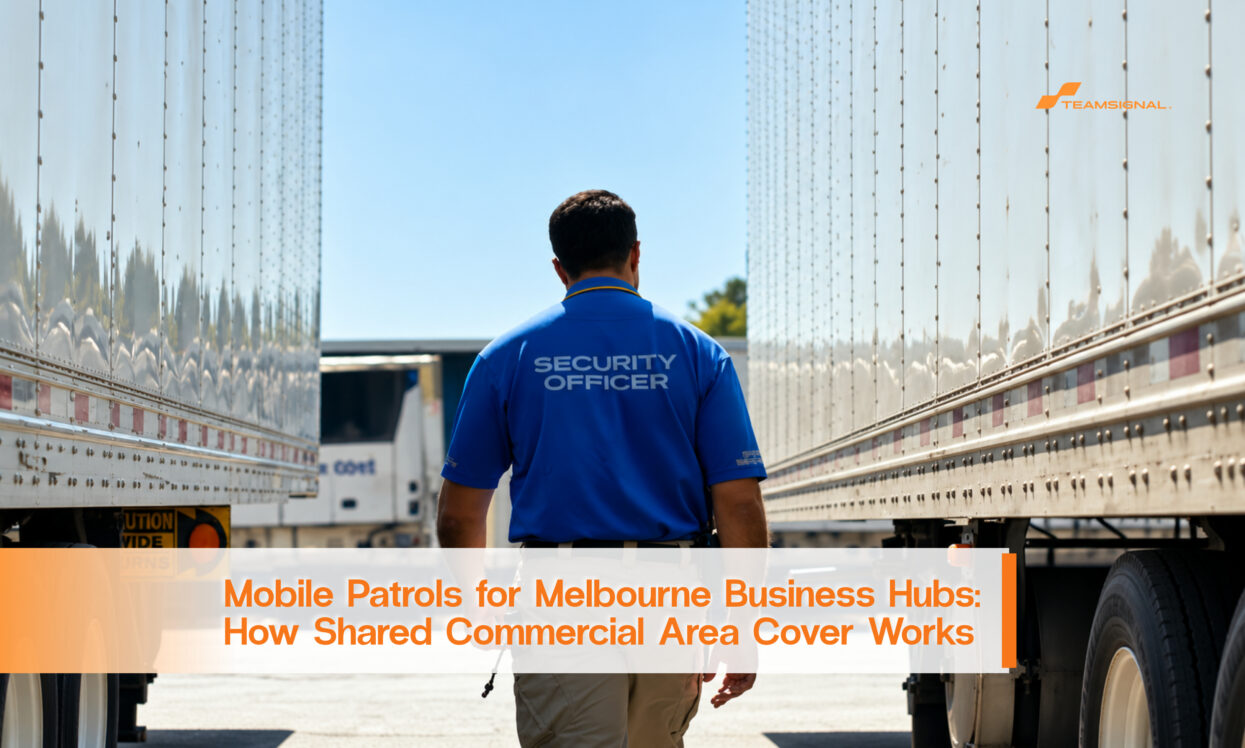
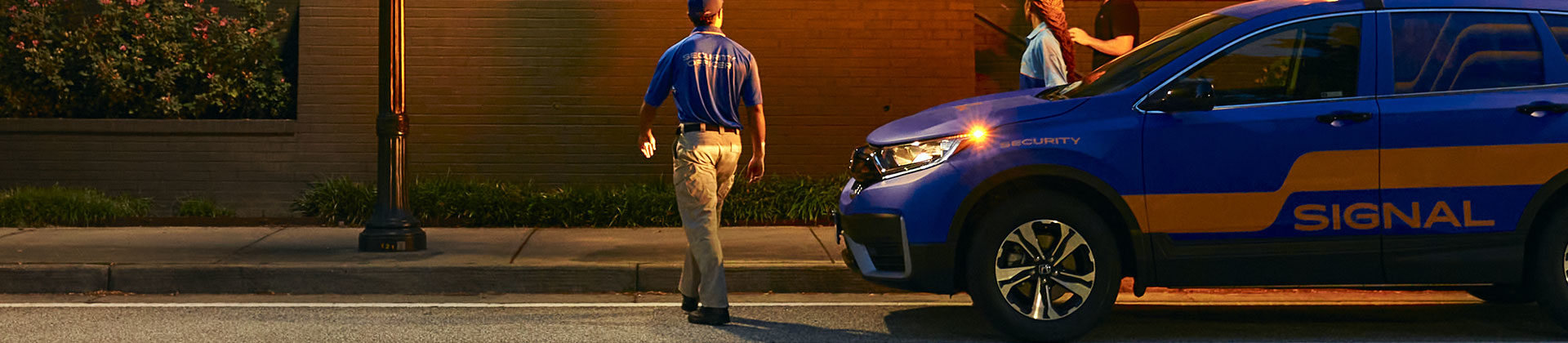
An officer visits each site in turn along an agreed route. At each stop they check entrances, gates, car parks and perimeters and report anything that needs follow-up. The visits can be scheduled, randomised or a mix of both.
The key difference from a single-site patrol is the route. Because the officer is already in the area, travelling between sites takes less time and costs less than sending a vehicle out to one location.
Shared cover works best where sites are close together and face similar risks.
Industrial estates. Many units sit side by side with shared roads and access points. Break-ins often target several units in the same night.
Shopping strips and local centres. Rear lanes, car parks and loading areas are exposed once shops close.
Office parks and business hubs. Large car parks, quiet buildings and shared entries need regular checks outside hours.
Franchise groups and retail chains. Several outlets across nearby suburbs can share a circuit and a single report format.
Trader associations and owners corporations. A group can agree on a common level of cover and share the cost.
If your site is isolated, remote or very large, a dedicated patrol is more likely to suit you. The difference is how many sites sit close to each other.
Our pricing guide explains that multi-site circuits usually lower the cost for each site, because one officer can cover several nearby sites in a single route. That's the main financial reason businesses band together.
The patrol vehicle, officer and travel time are shared. Each site pays for its own visits, but not for a whole dedicated vehicle. Visit frequency still matters most. Our guide on how mobile patrol pricing works explains how frequency, site size and contract length affect a quote.
We don't publish a standard rate, because it depends on the number of sites, their distance from each other and how often each is visited.
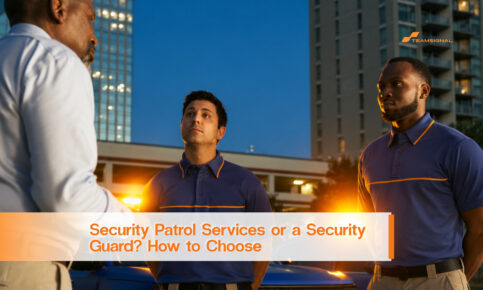
In a commercial area, the checks are practical and repeatable. An officer walks or drives the agreed route and checks nominated areas at each site. According to our local pages, that typically includes entrances, gates, car parks and perimeters.
Officers look for forced locks, open gates and doors, broken windows, cut fences, unfamiliar vehicles, signs of tampering and anything that looks out of place. If they find something, they record it, photograph it and report it to the right person. Our article on what happens on a mobile patrol visit walks through this in detail, including how each check is logged as it happens.
Business areas in Melbourne's east show how this works in practice. Our Croydon mobile patrol page explains that patrol plans are built around a site's access points, schedule and risks, and that patrol timing and frequency can be adjusted as needs change. Our Bayswater mobile patrol page covers warehouses, workshops, manufacturing facilities and distribution sites, and says reporting arrangements should be agreed before service begins.
Both pages describe the same principle. The route and the checks come from the site, not from a template.
Offenders look for the easiest option. If one site on a street is clearly checked and the next is not, the unchecked one stands out. When several neighbours share a patrol, there are fewer easy targets nearby.
There's research on the idea that focused presence helps. A Minneapolis study found that increasing police patrol at high-crime hot spots reduced crime calls by roughly 6 to 13 percent and halved observed disorder compared with similar spots. That was police patrol, not private security, so it's a guide, not a promise. But it supports the idea that targeting presence at the places and times of greatest risk is worth doing.
You don't need a formal group, but a little organisation helps.
Start the conversation. Talk to neighbouring businesses about shared problems. Bring up any incidents, graffiti, dumped rubbish or suspicious vehicles.
Agree the scope. Decide which sites are included, which areas will be checked and what times matter most.
Share the information. Agree who receives the reports and who is the point of contact. A single contact keeps things simple.
Agree how costs are shared. Each site might pay for its own visits, or an association might pay for the route and split it fairly.
Review regularly. Sites change. Revisit the route and frequency every few months, or after an incident.
Greater Dandenong City Council, for example, encourages businesses to get to know their neighbours or start a business-led network to share information and coordinate local measures. Sharing information is half the value.
Patrols work best alongside other layers. A monitored alarm gives you a response when something triggers between visits. Cameras give you evidence. Lighting and fences reduce the chance of an attempt in the first place.
Our alarm response service can be linked to patrols, so the nearest officer can attend a triggered alarm. If you want to understand how that works for your area, ask which vehicles are nearby at night.
When several businesses share a patrol, consistent reporting matters. Each site should get a clear record of what was checked and when, ideally in the same format. That makes it easy to compare across sites and spot patterns, such as a gate that is open every Tuesday.
Ask whether you can see only your own site's reports or a summary across the route. Agree this at the start.
If you're a trader or property manager who wants to start shared cover, here is a simple order of work.
First, find two or three neighbours who share your concerns. You don't need the whole street to begin. Second, write down what has happened in the last year, such as break-ins, graffiti, dumped rubbish or damage. A short list shows the group what the patrol is for. Third, agree what areas matter most, for example rear lanes, car parks or loading docks.
Fourth, ask one or two providers to quote on a route covering the group. Ask for the same details from each, including visit numbers, times, reports and costs. Fifth, agree how the cost will be shared, and who the provider will talk to. Sixth, set a review date, such as three months in, to check whether it's working.
Keep the group's expectations realistic. A shared patrol raises awareness and gives you records, but it's not a guarantee.
Cost sharing is where groups often stall. There are several fair approaches.
An equal split is the simplest. Each member pays the same amount. It suits sites of similar size and risk. A per-visit split charges each site for the visits it receives, which suits groups with different needs. A size-based split weighs the cost by frontage or floor area. An association levy collects a small amount from all members, and the association pays the provider.
Whichever method you pick, write it down. Agree what happens if a member leaves or a new one joins, because both are likely over time.
Shared patrols work well when each member gets clear information. Each site should receive a record of its own visits. Many groups also share a summary of anything affecting the whole area, such as a vehicle seen at several sites or an open gate on a shared lane.
Agree privacy rules at the start. Some details, such as alarm codes, key holders and security arrangements, should stay with each site. Share only what helps the group.
In shopping strips and business parks, the landlord or property manager may already pay for some security. Ask what is in place before you buy more. A patrol that overlaps with an existing arrangement wastes money, while a gap between two arrangements leaves an exposed spot.
If you rent, check your lease before changing locks, adding cameras or installing alarms. Some changes need written consent. A landlord may be glad to contribute if a shared patrol reduces damage to the building.
Victoria Police publishes business premises security tips covering locks, lighting, monitored alarms and cameras.
A shared patrol is a visit, not a permanent presence. Between visits, a site is not being watched by an officer. Visit frequency, timing and alarm response fill that gap, but they don't remove it completely.
A shared route also depends on distances. If sites are far apart, the officer spends more time travelling and visits are less frequent. Ask for a realistic estimate of how often each site would be visited.
Commercial area patrolling suits businesses that sit close together and share risks. One route, one reporting format and a shared cost can give each site more cover than it might afford alone. Start by talking to your neighbours, agree what you need and ask a provider to design the route around it.
If you want to explore shared cover for your area, talk to our mobile patrol team or get a quote.
What is commercial area mobile patrolling?
It's a mobile patrol that covers several nearby sites on one route, with an officer checking each site at agreed times and reporting what they find.
Is shared patrol cheaper than a single-site patrol?
Usually, yes. When one officer covers several nearby sites in one route, the cost for each site is generally lower than for a dedicated patrol.
Can neighbouring businesses share one patrol?
Yes. Agree the scope, the reporting contact and how costs are split. A provider can then design a route around everyone's sites.
How often will my site be visited on a shared route?
It depends on how many sites share the route, how far apart they are and the frequency you agree. Ask for a realistic estimate before you sign.
Do patrols replace alarms and cameras?
No. Patrols are one layer. Alarms give you a response between visits and cameras give you evidence.


 1300 893 606