Available Across Victoria – Contact Us Now!

Available Across Victoria – Contact Us Now!
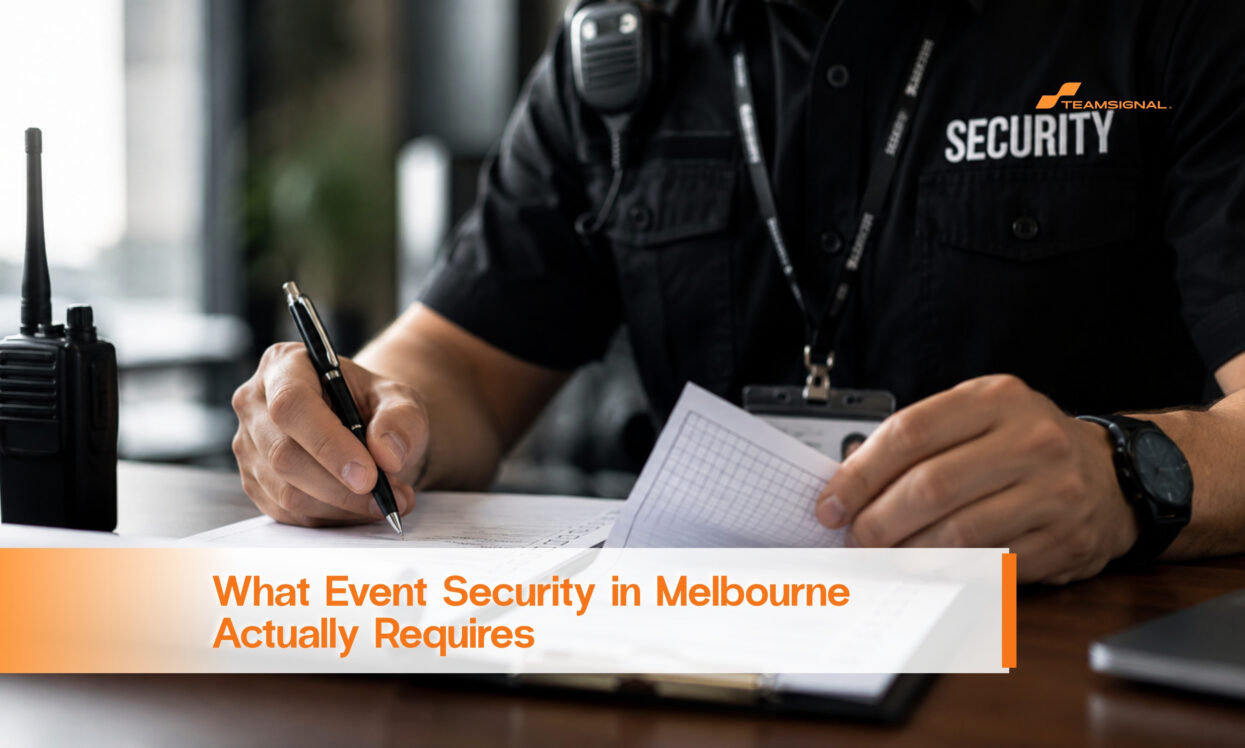
The venue asked for two.
A function organiser booking a 240-guest product launch in Richmond assumed two crowd controllers would cover it, the same number the venue used for a quiet Tuesday trivia night. It was not close. Under the ratio Victoria actually sets for licensed venues, 240 guests calls for four, not two, and the gap was not a judgement call anyone was free to negotiate down. It is a formula, published by the Victorian Government, and most people booking an event have never seen it.
That is the actual starting point for event security in Melbourne: not "how many guards do I need," which sounds subjective, but a specific, published ratio that removes the guesswork if you know where to look. TeamSignal Security is a full service security provider in Australia, and event bookings are one of the few areas of security where the state has actually done the maths for you.
The Victorian Government’s published guidance for security in licensed venues sets a specific formula: one additional crowd controller is required for every 100 extra customers, or part thereof, beyond the venue’s base requirement. The worked example the guidance itself gives is 240 customers requiring four crowd controllers, two for the first 100, one for the next 100, and one for the remaining group up to 100. This is not a TeamSignal recommendation, it is the state’s own published formula, and it is the number to check any quote or venue estimate against before an event, not after.
The formula applies specifically to licensed venues and events where alcohol is being supplied. A private function with no liquor licence involved does not automatically trigger this ratio, but as soon as alcohol is being sold or supplied under a licence, the ratio is a compliance requirement, not a suggestion.
Under Victorian Government guidance, crowd controllers working at licensed venues and events must hold a current individual licence, and organisers can check a crowd controller’s licence status directly on the Victoria Police public register, the same register that covers general security guard licensing under the Private Security Act 2004. Venues are also required to keep a register of the crowd controllers rostered on, available for inspection by liquor inspectors or police on request.
For an organiser booking security through a provider rather than a venue directly, this is worth confirming explicitly: ask whether every crowd controller assigned to the event is individually licensed and whether the provider maintains the register the venue may be asked to produce.
If the venue already holds a liquor licence and the event fits within its normal trading conditions, no additional licence is usually needed. Where an event sits outside that, a temporary limited licence, or a one-off event supplying alcohol, or a major event licence, for events expected to draw more than 5,000 people, is required under Victorian Government liquor licensing rules, administered by the Victorian Gambling and Casino Control Commission.
The major event threshold matters specifically because of timing: the government guidance recommends allowing a minimum of three months for a major event liquor licence application to be processed, which is well before most organisers start thinking about security at all. An event expecting a crowd near or above 5,000 that has not started this process by the three-month mark is already behind, regardless of how good the security plan itself is.
Where a licensed venue’s conditions require security cameras, the Victorian Government specifies exactly what that means, not just "have some cameras." The requirements include coverage of all entrances, bars and entertainment or dance floor areas, recording in an unbranded format at a minimum of 8 frames per second, timestamped with date, time and camera location, and footage retained for at least 4 weeks and made immediately available to police or liquor inspectors on request.
An event held at a venue with these conditions attached inherits them for the duration of the event. If an organiser is bringing in temporary or supplementary CCTV coverage for the event, checking it actually meets these specifications, not just that cameras are present, is worth doing before the event rather than discovering a gap if an incident happens.
The organisers who get an accurate, defensible quote are the ones who arrive with specifics rather than a headcount. At minimum:
A provider working from this information can quote against the actual ratio and licence requirements rather than a rough guess, which is usually where the Richmond launch’s two-versus-four gap came from in the first place, a quote built on attendance alone, without checking what that attendance actually required.
This is usually the part organisers assume is the venue’s problem alone. It is not quite that simple.
The liquor licence, and the conditions attached to it, sit with the venue or the event’s licensee, not with whoever booked a function room for an evening. If a licensed venue is required to keep a register of rostered crowd controllers available for inspection, that obligation belongs to the licensee. But an external event organiser who books security independently, rather than relying on whatever the venue arranges, is the one who actually knows the true attendance figure and the actual event structure, information the venue may not have if the booking came through an external planner or promoter.
In practice, this means the organiser and the venue both have a stake in getting the ratio right, and neither should assume the other has already checked it. The Richmond launch organiser assumed the venue’s estimate was correct because it came from the venue. The venue’s estimate was based on its usual Tuesday numbers, not the actual guest list for that specific event. Confirming the ratio independently, using the actual expected attendance, is a five-minute check that would have caught the gap before the guest list closed rather than at the door.
Everything above assumes security gets booked with enough lead time to actually plan against it. The most common failure point sits earlier than that: organisers who finalise a venue and date, then treat security as a task for the final fortnight.
Licensed crowd controllers are a limited pool, particularly around weekends, public holidays and the lead-up to Christmas and New Year, when demand across Melbourne’s events calendar peaks at once. An organiser who leaves booking until two weeks out is not just risking a worse quote, they are risking a provider being unable to supply the number the ratio actually requires, which puts the event in the position of either scaling back or proceeding under-resourced.
The practical fix is treating the crowd controller booking the same way a venue booking is treated, confirmed against the date as early as the guest list estimate is available, not after invitations go out. For any event approaching the major event threshold, this timing matters even more, since the licence itself can take three months to process before security numbers are even the next question.
The Richmond launch organiser was not wrong to trust the venue’s estimate. The estimate was just built the same way most are, on habit rather than the actual published ratio. Getting this right early is not complicated once you know the formula exists, it just has to happen before the event, not during it.
If you are planning a Melbourne event and want a security plan built against the actual requirements rather than a guess, our team can work through the numbers with you directly. You can see our event security services in Melbourne.
Under Victorian Government guidance for licensed venues, the formula is one additional crowd controller for every 100 extra customers or part thereof. The published worked example is 240 customers requiring four crowd controllers. This applies specifically where the event is licensed to supply alcohol; check the exact figure against your expected attendance rather than estimating.
If the venue’s existing liquor licence covers your event’s conditions, usually not. If it does not, a temporary limited licence covers most one-off events supplying alcohol, while events expecting more than 5,000 people need a major event liquor licence, administered by the Victorian Gambling and Casino Control Commission, which the government recommends applying for at least three months in advance.
Yes. Under Victorian Government requirements, every crowd controller working a licensed venue or event must hold a current individual licence, checkable on the Victoria Police public register. Venues and providers are also required to keep an accessible register of rostered crowd controllers for inspection.
Where required, cameras must cover all entrances, bars and entertainment or dance floor areas, record in an unbranded format at a minimum of 8 frames per second, include time, date and location stamps, and be retained for at least four weeks and available to police or liquor inspectors immediately on request. An event held at such a venue inherits these conditions for its duration.
Victorian Government, Security in licensed venues (vic.gov.au), crowd controller ratio, licensing and CCTV requirements. Cited directly in the body above.
Victorian Government, Major event liquor licence (vic.gov.au), and Victorian Gambling and Casino Control Commission guidance on major and temporary limited event licences. Cited directly in the body above.
Private Security Act 2004 (Vic), individual licensing basis referenced via crowd controller licensing above.



 1300 893 606